



Nouvelles
Page de garde > Nouvelles > Nouvelles de la société > Copper electrolytic cell: The core of precise purification in modern copper smelting.
In the copper smelting chain, the copper electrolytic cell plays the role of the ultimate "gatekeeper" for refining. It receives the crude copper anode plates produced by the pyrometallurgical process and, through the magic of electrochemistry, transforms them into cathode copper with a purity of over 99.99%, efficiently concentrating precious metals. It is a crucial link in the entire process for value enhancement and element separation.
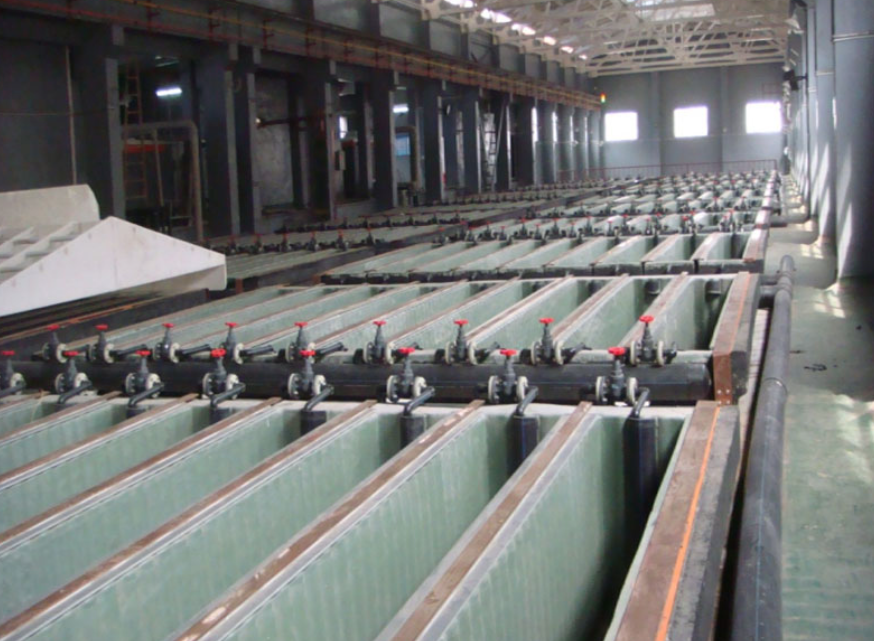
This refining journey begins with carefully prepared anode plates. These heavy plates, cast from crude copper, consist primarily of copper, but also contain base metals such as nickel and iron, as well as precious metal impurities like gold and silver. They are systematically placed in a copper electrolytic cell containing an acidic copper sulfate electrolyte, forming the anode, while pure copper starter sheets act as the cathode, both connected to a DC power supply.
Upon electrification, precise chemical selection occurs within the copper electrolytic cell. At the anode, copper and more reactive metal impurities preferentially dissolve into ions in the solution; while precious metals such as gold and silver, and some inert components, detach due to their insolubility, settling at the bottom of the cell to form valuable "anode slime." At the cathode, copper ions in the solution are preferentially reduced, depositing as dense, high-purity cathode copper. Other impurity ions with more negative potentials are suppressed in the electrolyte, thus achieving perfect separation of copper from impurities. The entire process is controlled by precisely adjusting current density, temperature, and additives to ensure the smooth and excellent quality of the cathode copper.
After several days to two weeks of deposition, the products are separated one by one: the heavy cathode copper is produced as the final product; the anode slime, rich in gold, silver, platinum, palladium, selenium, and tellurium, is collected as a valuable raw material for comprehensive recycling; and the electrolyte, after purification to remove accumulated impurities such as nickel and arsenic, is returned to the system for recycling.
Thus, the copper electrolytic cell is far more than just a simple reaction vessel. It is the core of deep purification of crude copper into industrial-grade high-purity copper, a platform for efficient enrichment and recovery of valuable elements, and an engineering paradigm that utilizes electrochemical principles to achieve precise element separation. On the path from ore to high-purity metal, the copper electrolytic cell ensures the excellent electrical conductivity and mechanical properties of the final product, laying the foundation for modern copper material applications.